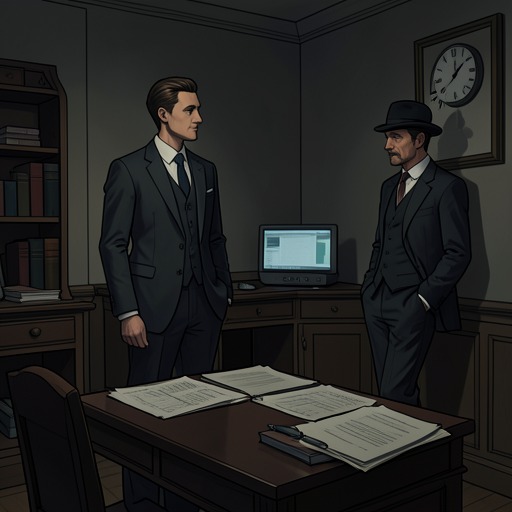
Inspector Marriot
Partners in CrimeInspector Marriot is a Scotland Yard detective who repeatedly turns up at the point where Tommy Beresford and Tuppence Beresford’s private inquiries intersect with official police work. He is neither an omniscient authority nor a mere obstacle: his investigations can be tentative, his conclusions sometimes too confident, and his cooperation with the Beresfords essential to bringing several cases forward.
Identity and Introduction
Marriot identifies himself as a Detective Inspector of Scotland Yard when he arrives at the Beresfords’ home. His entrance interrupts Tuppence in the middle of a confrontation with Beatrice Kingston Bruce: the girl tears herself away and rushes downstairs as the front door opens to admit Mr. Rennie. Marriot’s arrival changes the immediate balance of the scene, but it also exposes a practical difficulty for the amateur investigators. Tuppence bitterly remarks that his presence has spoiled what she was doing, suggesting that the official arrival has disrupted their attempt to manage the encounter themselves.
His standing is formal, but his manner is often companionable. He appears in the later investigations not simply to take over, but to exchange findings, ask the Beresfords for help, and recognize their contribution. That mixture of police authority and genial familiarity defines his recurring place in their work.
Work with the Beresfords
In the Lady Merivale case, Marriot reports the first results of the police inquiry. The murdered woman has been identified as Lady Merivale, and Sir Arthur Merivale has recognized her body. Marriot has also asked Sir Arthur whether he knows anyone called Bingo, establishing that the police have connected the name spoken by the dying woman with Captain Bingo Hale. Sir Arthur describes Hale as his dearest friend, a frequent presence in the household, and someone staying at his house when he was arrested that morning. Tuppence insists that the victim’s words were unmistakable. Marriot’s report thus brings the official identification and arrest into the same conversation as the Beresfords’ direct attention to what Lady Merivale said.
The case seems to Marriot unusually straightforward once the police have assembled their evidence. He says the dagger belonged to Lady Merivale and that the apparent intention was to make her death look like suicide. He also describes letters showing that Lady Merivale and Captain Hale had been involved for some time without Sir Arthur’s knowledge. The final link, according to Marriot, is a fragment of the Daily Leader torn from the clothing Hale wore and matching the fragment found in the investigation. He brings photographs of the two exhibits to show the Beresfords. His repeated confidence that the case is clear becomes a small point of comic friction: after he leaves, Tuppence asks why he keeps saying so, while Tommy can only speculate that Marriot is pleased with himself. The episode presents police evidence as a chain of tangible links, while allowing the couple to notice the manner in which the officer announces the chain as complete.
Marriot also makes the Beresfords active partners in the inquiry into counterfeit notes. After briefly coaching them, he explains that the notes are being circulated from the West End and also passed across the Channel. The suspected distributor is likely to be socially prominent. He draws their attention to Major Laidlaw, a figure associated with racing whose past and sources of money are obscure. Marriot does not claim to have proof against him; instead, he describes a general suspicion arising from questionable transactions and asks the Beresfords to investigate. His request makes the limits of police knowledge explicit: the authorities have a person of interest and a pattern of circulation, but still need evidence that can turn suspicion into a case.
Police Methods and Collaboration
Marriot’s approach combines patient observation with direct intervention. In the Hank Ryder investigation, the back door of the house is flimsy, and its lock gives almost immediately as an assault is made on the front. Marriot appears in the doorway at the decisive moment. Tommy greets him as having judged the district correctly and introduces Ryder, while explaining that he had already suspected him. The arrest therefore belongs to a coordinated operation: Marriot and the police arrive, but Tommy’s suspicions and preparations have helped bring them to the right place.
The Beresfords’ methods in that operation also show why Marriot’s official role matters. Tommy says he had instructed Albert to follow by motorcycle if he and Ryder went out joy riding. At the same time, Tommy marked a chalk cross on the door to draw Ryder’s attention and emptied valerian onto the ground; neighborhood cats gathered at the right house, helping Albert and the police locate it. Marriot’s arrival completes the plan, joining an unconventional signal and surveillance arrangement to police action. The scene makes the contrast between the couple’s improvisation and the detective’s institutional authority productive rather than adversarial.
In the case involving Porcupine Assurance, Marriot admits that the police had been dissatisfied with the company’s figures and suspicious of the Hollabys, but had not found grounds on which to proceed. The murder unsettled their assumptions. After the Beresfords develop an idea involving a blue coat, Marriot says he will confront young Hollaby with Doris Evans and see whether she recognizes him. He also promises that Blunt’s Brilliant Detectives will receive credit for the idea. His acknowledgment is significant: he is willing to credit the private investigators publicly, and his next step depends on testing a proposed identification rather than treating suspicion as proof.
Character and Narrative Role
Marriot’s recurring function is to connect separate stages of inquiry: identification, evidence-gathering, suspect assessment, and intervention. His reports often establish what the police have learned, while the Beresfords contribute observations or imaginative methods that the official investigation has not yet supplied. The relationship is therefore collaborative but not identical. Marriot works within the police service and its evidentiary limits; Tommy and Tuppence move between cases by adopting detective-fiction personae and devising theatrical schemes.
The contrast is especially clear in the Beresfords’ role-playing. They discuss learning from detective-story masters, and Tommy later declares that they will become the brothers Okewood when danger threatens their assumed identity as Blunt. Tuppence challenges the assignment, preferring to be the more capable brother. Elsewhere she urges Tommy to use his little grey cells and to be Watson, drawing on the language of famous fictional detectives. Marriot’s professional presence gives these performances a real-world counterpart: the couple can borrow the forms and catchphrases of detective fiction, but cases still require identification, corroboration, and cooperation with the police.
In the Porcupine investigation, Marriot himself participates in the joke of shared professional familiarity. He has been listening to Tommy’s conversation from the next table while eating a poached egg, then reveals that the Yard has suspected the Hollabys without being able to act. His casual lunch-time appearance makes official surveillance seem less ceremonious than the Beresfords’ dramatic performances, but the substance of his disclosure is serious: the murder has changed how the police understand the figures, and the new lead may allow them to test their existing suspicions.
Significance
Marriot is characterized less by a private history than by the changing quality of his cooperation with the Beresfords. He can arrive at an awkward moment, deliver a confidently framed case, admit uncertainty about a suspect, or enter at exactly the moment an arrest becomes possible. These variations keep him from functioning as a simple symbol of either police competence or police failure. His cases show both the value and the limits of formal investigation: the police can gather exhibits and pursue suspects, but the Beresfords’ attention to speech, costume, disguise, and circumstance can supply leads that the official inquiry lacks.
That partnership also supports the book’s comic play with detective conventions. The Beresfords treat celebrated fictional methods as styles to try on; Marriot represents the consequential work those styles imitate. A torn newspaper fragment, an uncertain lead about a racing figure, the possible recognition of a suspect, and the cats that guide police to Ryder’s house each belong to a different scale of evidence or ingenuity. Across them, Marriot’s role is to bring the case back from performance to procedure, while remaining willing to let the amateurs help shape what the police do next.